
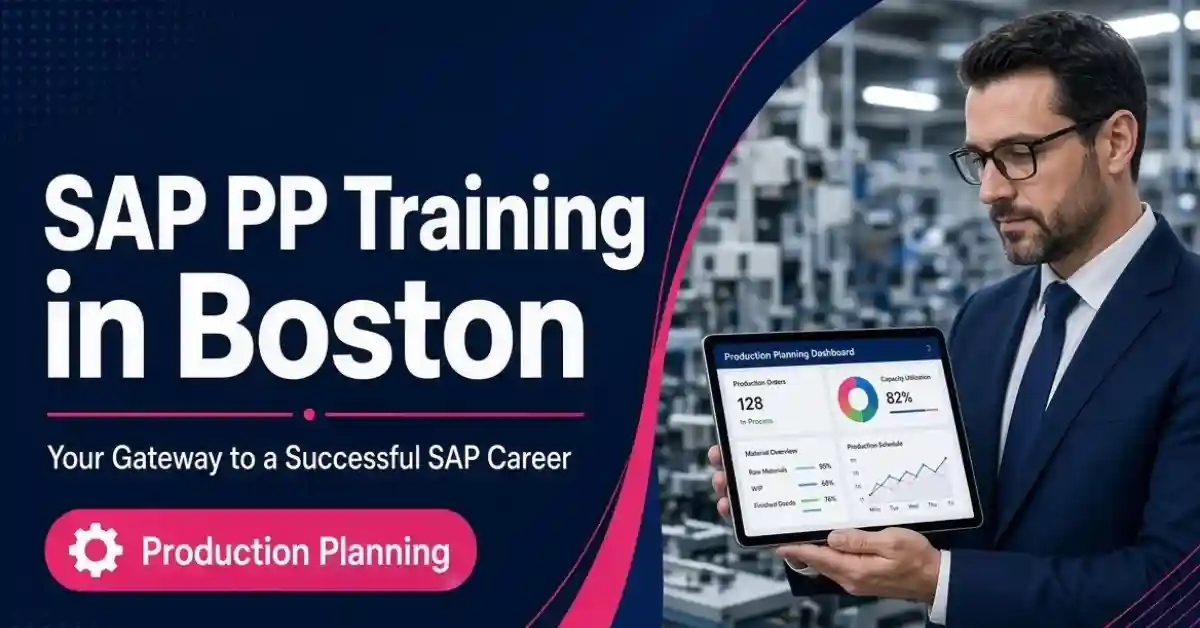
SAP PP Training in Boston: Build Your Career in Production Planning
Manufacturing businesses need efficient production planning, accurate material requirements, and effective resource management to meet customer demand. SAP Production Planning (PP) helps organizations coordinate manufacturing activities by connecting production schedules, materials, inventory, and other business processes within an integrated ERP system.
For students, graduates, manufacturing professionals, and working professionals looking to develop ERP expertise, SAP PP Training in Boston offers a structured way to understand production planning concepts and gain practical knowledge of SAP systems. Learning SAP PP can help professionals build skills relevant to manufacturing, operations, supply chain, and enterprise technology.
What is SAP PP?
SAP PP, or Production Planning, is an SAP module that supports manufacturing and production-related business processes. It helps organizations plan production requirements, manage material availability, schedule operations, create production orders, and monitor manufacturing activities.
SAP PP integrates with other SAP modules, including Materials Management (MM), Sales and Distribution (SD), and Finance (FI). This integration helps businesses coordinate production with purchasing, inventory, sales demand, and financial operations.
SAP S/4HANA provides modern capabilities for managing production planning and manufacturing processes. Understanding SAP PP can help learners recognize how ERP technology supports efficient production and business decision-making.
Why Choose SAP PP Training in Boston?
Boston has a diverse business environment that includes technology, biotechnology, medical devices, healthcare, manufacturing, and other industries. Businesses involved in producing goods need reliable processes for managing materials, production schedules, resources, and inventory.
Choosing SAP PP Training in Boston can help learners develop specialized SAP knowledge and understand how production planning works within an ERP environment. Professionals with experience in manufacturing, engineering, operations, or supply chain management can build on their existing skills by learning SAP PP.
For beginners, structured training provides a foundation in SAP concepts and production planning processes. For experienced professionals, it offers an opportunity to connect industry knowledge with SAP-based manufacturing operations.
What Will You Learn in SAP PP Training?
A comprehensive SAP PP course in Boston should cover essential concepts along with practical manufacturing scenarios. Depending on the course curriculum, learners may explore:
- SAP PP organizational structure
- Material master data
- Bill of Materials (BOM)
- Work centers and routings
- Production versions
- Demand management
- Material Requirements Planning (MRP)
- Production planning processes
- Capacity planning concepts
- Planned orders and production orders
- Goods movements
- Production confirmations
- Production order settlement concepts
- Make-to-stock and make-to-order production
- Integration with SAP MM and SD
- SAP S/4HANA Production Planning concepts
- Practical manufacturing scenarios and exercises
Hands-on SAP system practice can help learners understand how production requirements are planned, how orders move through the production cycle, and how materials and inventory are connected to manufacturing activities.
Who Should Join SAP PP Training?
SAP PP Training in Boston can be suitable for learners from different educational and professional backgrounds, including:
- Manufacturing professionals
- Production planners
- Supply chain specialists
- Operations professionals
- Inventory and materials professionals
- Engineering graduates
- Business administration graduates
- Logistics professionals
- ERP professionals
- SAP beginners
- Working professionals planning a career transition
A manufacturing background can be helpful, but beginners can also learn SAP PP through a structured course that starts with the fundamentals and gradually introduces more advanced topics.
Benefits of Learning SAP PP
Learning SAP PP can help professionals combine manufacturing knowledge with enterprise technology skills.
Understand Production Planning: Learn how organizations coordinate materials, resources, capacity, and production schedules to meet business requirements.
Develop Practical SAP Skills: Hands-on exercises can help learners understand production transactions and workflows within an SAP environment.
Gain SAP S/4HANA Knowledge: Develop familiarity with modern production planning concepts and integrated manufacturing processes.
Understand Cross-Module Integration: Learn how production planning connects with procurement, inventory, sales, and other SAP functions.
Expand Professional Skills: SAP PP knowledge can complement experience in manufacturing, engineering, operations, and supply chain management.
SAP PP Training with Career Support
A career-focused SAP PP training program in Boston can offer more than technical instruction. Practical assignments, SAP server access, recorded sessions, resume preparation, mock interviews, and interview guidance can help learners strengthen their understanding and prepare for SAP-related opportunities.
Practical assignments allow learners to work through production planning scenarios and reinforce concepts covered during training. Mock interviews can help candidates practice explaining SAP PP processes and responding to questions about manufacturing workflows.
For professionals transitioning from manufacturing or supply chain roles into SAP, resume-building support can help present previous industry experience alongside newly acquired SAP skills. Certification preparation can also help learners organize their learning and review important topics.
How to Choose the Best SAP PP Training Institute in Boston?
Before enrolling in an SAP PP course, evaluate the curriculum, instructor experience, practical SAP system access, course duration, S/4HANA coverage, learning resources, and career support.
Look for a program that offers live instructor-led sessions and opportunities to practice SAP PP processes. It is also useful to check whether the course includes assignments, recorded classes, mock interviews, certification preparation, and job guidance.
A well-structured SAP PP course in Boston should help learners progress from basic SAP concepts to practical production planning processes and realistic manufacturing scenarios.
Conclusion
SAP PP plays an important role in connecting production planning with materials, inventory, demand, and manufacturing operations. SAP PP Training in Boston can help students and working professionals develop practical Production Planning knowledge while gaining exposure to SAP S/4HANA concepts.
With structured training, hands-on practice, certification preparation, and career-focused support, learners can build a foundation for pursuing opportunities in SAP PP, production planning, manufacturing, supply chain, and ERP-related roles.